New article on Sogdian rhyta

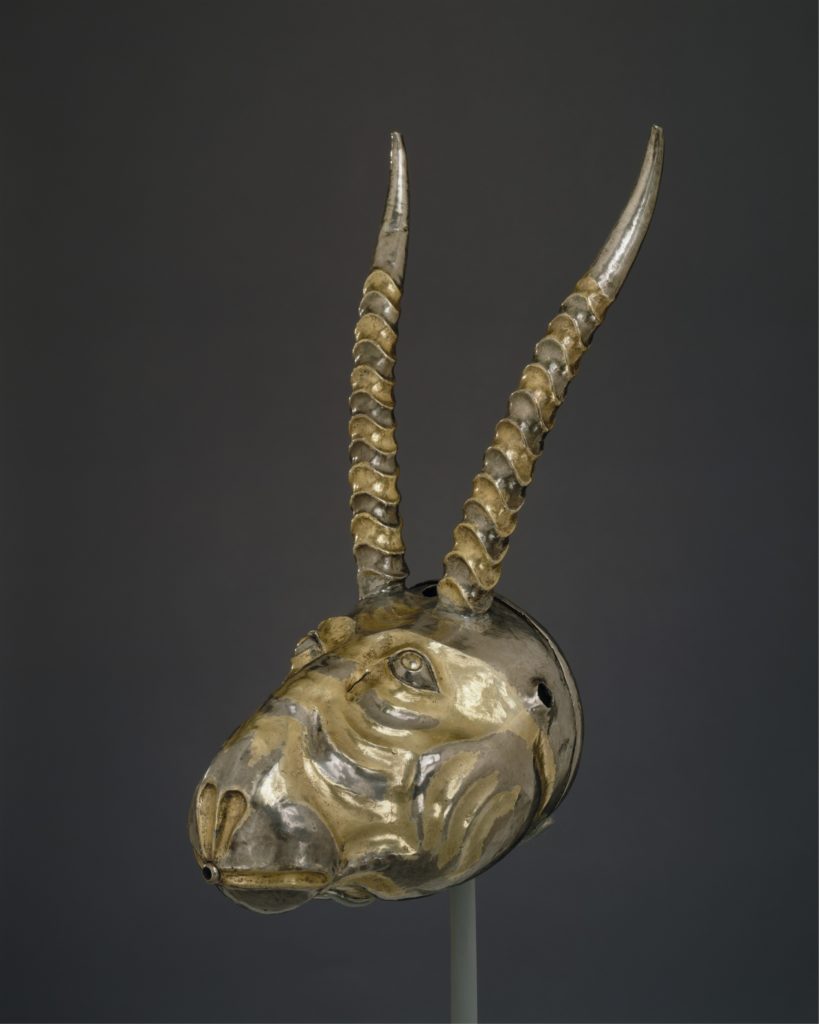
Rhyton in the form of a Saiga antelope head, Sasanian, ca. 5th–6th century A.D. Silver-gilt, 11.1 x 7.09 in. (28.19 x 18.01 cm). Rogers Fund, 1947. New York, Metropolitan Museum of Art, 47.100.82.

I am happy to report that my friend and former Met colleague Betty Hensellek has just published a wonderful article entitled “A Sogdian Drinking Game at Panjikent” (Iranian Studies 52, 837-857). Betty argues that the banqueting murals from Panjikent illustrate a drinking game involving rhyta, and that the relative success of the participants is indicated by the manner in which they wear their kaftans. It is an ingenious study of social history, drinking vessels (including the Saiga antelope head’s rhyton at the Met, pictured above) and modes of dress, and I highly recommend it!

New front runner for weirdest job ad

Last month I posted about a truly bizarre Classics job ad at a Canadian university. Today I came across an ad that tops this one, a postdoc at my alma mater the University of St. Andrews. It is for two four-year research fellows, one specializing in the ‘history of rat-catching,’ and the other in the history of ‘rat-proofing.’ These are part of a project in St. Andrews’ Department of Social Anthropology, sponsored by the Wellcome Trust, entitled ‘The Global War Against the Rat and the Epistemic Emergence of Zoonosis.’ Much as I would like to a) go back to Scotland, and b) have the job title of ‘Research Fellow in Rat-Catching,’ I am unfortunately not qualified for this post, as I lack adequate knowledge of rats. But I encourage those with relevant qualifications to apply!

So much for Novae Famae 2019-20

NF19 has already crashed and burned. Despite the best intentions of its organizers, someone posted a link to an inane SCS op-ed, and the site immediately descended into the racism and vitriol that made its predecessor so unbearable. One need not look any further to see that a) classics is doomed, and b) rightly so.

Proofs

Apparently it’s proofs season here, since I’ve been busy reading a lot of my own writing lately, looking for errors that should long since have been corrected (by me). The good news is that all of these things will actually be published soon. They include:

Archaeology of Empire in Achaemenid Egypt. Edinburgh Studies in Ancient Persia. Edinburgh: Edinburgh University Press, 2020. (This should be available in November 2019; download the discount flyer here.)

“The Canon of Ancient Iranian Art: From Grand Narratives to Local Perspectives.” In Amy Rebecca Gansell and Ann Shafer (ed.), Testing the Canon of Ancient Near Eastern Art and Archaeology. Oxford: Oxford University Press, 2020. (This should be available in November or December 2019. It looks like my title was changed; probably I agreed to it and don’t remember. I wrote this paper back in 2015, and it was instrumental in getting me my current job. I’m really happy to see it in print finally.)

“An Urartian Belt in the J. Paul Getty Museum and the Origin of the Parthian Shot.” Getty Research Journal 12 (2020). (Co-authored with Alexis M. Belis; this will be published in the spring of 2020. It publishes a belt in the Getty villa and explores the history of the Parthian shot motif, including an argument that it originated in Urartu. This was a fun article to write.)

Weirdest job ad

If I were to give an award for the weirdest job ad, there would be a new contender as of today.  I won’t name names, but I will quote the ad itself, which is for an ‘Assistant Professor with specialization in Mediterranean Identity and Race in Antiquity,’ and it will be obvious that the position is at a Canadian university:

The Ideal candidate will be someone, who can design and teach courses such as “Ancient Colonization and Diasporas,” “Warfare in the Ancient world” and “Slavery in the ancient Mediterranean,” which emphasize the strategies all cultures involved developed for mutual interaction, connection and inclusion.  The successful candidate – Ideally a qualified scholar from an equity-seeking group – will be expected to initiate a high-quality research program on Greco-Roman interaction with the diverse indigenous populations of the Mediterranean, exploring parallels with the Canadian indigenous experience.  This research, which is competitive for funding through Canada’s tri-council awards, will have independent facets, but also entail collaboration with colleagues in another field or fields, such as Art History, Gender Studies Geography, History, Languages Literatures and Cultures, Linguistics, Religious Studies and Sociology.  By involving students, the research will further enhance the Department’s strong emphasis on experiential learning.

This ad is for a unicorn. If they fill this position with someone who actually meets all of these qualifications, I’ll eat my hat. Of course, they may already know of someone who meets these qualifications, but this is how rumors get started…
It begins…

I am sorry to say that I have just submitted my first job application of the 2019-20 season. It was a damnably depressing thing to do, even if the job itself is a good one. I don’t have any reason to be optimistic, and that’s because I’ve come to learn that hiring decisions are functionally random. I don’t mean to say that the name of the successful candidate is simply pulled out of a hat, but rather that it is impossible to predict or gauge the selection criteria. ‘Merit’ is ill-defined and subjective, and sometimes, but not always, it loses out to cronyism and/or good looks. I’ve seen many seemingly under-qualified candidates get picked over me for jobs, and as a result the older I get the less I understand the market. The only comfort I’ve received is that I now know that if my wife gets a job before I do I’m going to narrow my search to focus on her new employer’s location. It’s more important for us to be together than to try to game the system somehow for an ideal position — after all, you can’t game a system that is functionally random!

My essay on the canon of ancient Iranian art

I have just received the proofs for my essay “Ancient Iranian Art: From Grand Narratives to Local Perspectives,” which will be published in Testing the Canon of Ancient Near Eastern Art and Archaeology, edited by Amy Gansell and Ann Shafer (Oxford University Press), sometime this winter. I’m even getting a couple of color images for my essay, which is very exciting.

I have a great fondness for this essay because it was the first thing I wrote that made me feel explicitly like a scholar of ancient Iran, and not just a peripheral classicist (though I still feel like a peripheral classicist). In many respects it marked my transition from working on Egypt to working on Iran, though of course I continue to produce scholarship on Achaemenid Egypt (I agreed to another one yesterday). This essay also helped me to get my current position at the Met, for which I am enormously grateful, and it informs the work I do every day on the planning for the re-installation of the Ancient Near Eastern galleries.

So buy the book! I’ll tell you how when it’s published.

Novae Fama is dead! Long live Novae Famae!

Novae Famae, the vitriolic, un-moderated successor to Famae Volent, the classics job message board, has gone the way of the dodo. In its place has risen, phoenix-like, Novae Famae 2019-20, which, from the comments posted on its landing page, seems to aim to restore some order, with the restoration of moderators and the re-establishment of rules addressing slander, hate speech and naming names. Most significantly, NF19 (my own coinage!) insists on user IDs for commentators. If I understand correctly these are still functionally anonymous, but they will permit such things as responding to specific posters or even banning them if necessary.

In my view the death of Novae Famae is a good thing; it will not be missed. However, I learned one very important thing from it: classicists are not in the vanguard of humanistic studies the way they once were. Rather, it seems that a significant subset of them are trying desperately to maintain a fossilized academic field, on the premise that the Greeks and Romans are somehow more special than any other ancient (or modern) peoples, which is very foolish. I was distressed to find out how vocal, and oftentimes bigoted, this subset is. It has furthered the alienation I feel from the classics, a topic which I have studied for more than half my life (and I say this as a 36-year-old).

I don’t have any moralizing notes on which to end, save for my usual refrain that I think classics is doomed, and rightly so.