The OI is dead! Long live the…ISAC-WANA?

I’m sure you’ve all been watching the news with bated breath today (no, not the thing about the fat guy getting arrested in New York); I certainly have. But what to make of the result? I offer my uninformed impressions below, in no particular order:

  1. Yes! It was long overdue. ‘Oriental’ was never a good name for the OI, since that implies it studied all of Asia, which it did not. Now it’s an even worse name, but of course the strength of the OI brand surely made it difficult to decide to change. I therefore applaud the OI for having the courage to do so. Never fear, us OI watchers still know who you are, no matter what you call yourself.
  2. Double yes! I appreciate that the OI tried to find a name that actually encompassed what it does, as opposed to, say, the recently rebranded ‘American Society of Overseas Research,’ which, desperate to preserve its acronym, came up with a truly meaningless name. It sounds like a travel agency for retirees (which, frankly, is not too far off). I also credit the OI for not trying to spell anything with its new acronym (though I think I went to high school with an Isaac Wana).
  3. It’s a mouthful, to be sure. It’s also weirdly similar to ISAW, which I’m sure the OI leadership noticed. And the result is somewhat uneven. On the one hand, ‘ancient civilization’ is a lot more than just ancient Egypt and Sudan and the Near East/West Asia. On the other, the subtitle is pretty awkward. I cannot help but wonder if the OI couldn’t have just expanded its remit. To be frank, the OI could have called itself the ‘Institute of Biblically Relevant Peoples’ to accurately describe its intellectual heritage. Indeed, in this respect the name ‘Harvard Semitic Museum’ was weirdly honest.

Of course, my real question has nothing to do with the OI’s name, but with its marvelous publication series (to which I have an extremely tangential connection). Will ‘Studies in Ancient Oriental Civilization’ become ‘Studies in Ancient Cultures: West Asia and North Africa’ (SACWANA?). And will we also see ACWANAP? All I know is that my bibliographies are about to get more complicated…

In memoriam Lance Reddick (1962-2023)

Today it is my sad duty to commemorate the passing of Lance Reddick. He was easily one of my favorites, not least for his distinctive saunter, and to an extent I felt like I knew him because his best roles (in my humble view) created a sort of cursus honorum.

First he was Lt. Cedric Daniels in The Wire.

Then he joined Homeland Security as Philip Broyles in Fringe:

Then, not to rest on his laurels, he ended up as chief of the LAPD in Bosch:

As careers go, in acting or in law enforcement, this is a meteoric rise, and, in my view anyway, well deserved. I am sad I will never see him as Chairman of the Joints Chiefs, Secretary of Defense, or Vice President. He would, I’m sure, have been tremendous in all of those roles.

Hold onto your potatoes!

As an archaeologist, and, well, as a human being, I wish to congratulate Ke Huy Quan on his Oscar. My eight-year-old self definitely wanted him to win for Indiana Jones and the Temple of Doom (to be clear, I was 1 when that film was released; I had to wait a few years to watch it).

Everything Everywhere at Once is no Temple of Doom, but it’s a fine picture to be sure. (Michelle Yeoh was tremendous in it). I’m especially impressed by the fact that Ke Huy Quan hadn’t acted in 20 years before this role. It gives me hope for my own lackluster career, and of course fills me with childish glee.

And speaking of ‘archaeological’ film stars, congratulations also to Brendan Fraser.

Let’s Get Ready to Rumble!

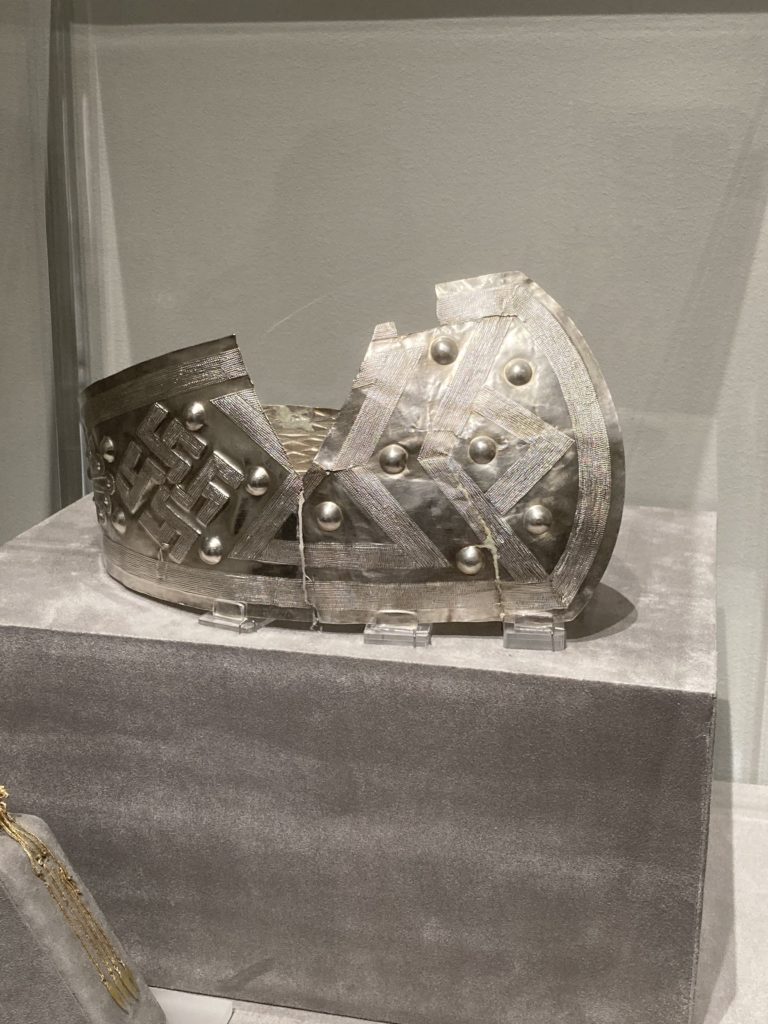
Yesterday I finally went to see the exhibition Ritual and Memory: The Ancient Balkans and Beyond at NYU’s Institute for the Study of the Ancient World. Great stuff as always, and it was especially wonderful to see the Borovo rhyta. But perhaps the most startling revelation the exhibition has to offer is that professional wrestling was invented in Serbia in the early fifth century BCE, as attested by this championship belt from Vinča:

National Museum of Serbia 06_25647

The belt looked too small to fit me, so I imagine the pro wrestlers of yesteryear were rather petite compared to modern man-mountains like Hulk Hogan and the late great André the Giant. (It should be clear from this post that my knowledge of professional wrestling peters out around 1990, when I turned seven.) All that remains to confirm this remarkable discovery would be for archaeologists to unearth the first folding metal chair.

In memoriam Amélie Kuhrt (1944-2023)

I have just received the distressing news of the death of Amélie Kuhrt, one of the foremost historians of the Achaemenid Empire and the ancient Near East more generally. Along with Heleen Sancisi-Weerdenburg she was the driving force behind the Achaemenid History Workshops in the 1980s that helped to create a new paradigm in Achaemenid studies. Her two-volume history of the ancient Near East, published in 1995, was remarkable for its inclusion of Egypt and its overall level of detail. I would not have survive grad school without it. And her 2007 book, The Persian Empire: A Corpus of Sources from the Achaemenid Period (also two volumes) is a landmark achievement and perhaps the single most useful publication for anyone studying the Achaemenids. I cite it in almost everything I publish; in fact, I am opening it now for an essay I have just begun to write. She wrote tremendously good articles, too–not very many, but they all have aged better than Vanna White.

On a personal note, we communicated some by email a number of years ago; in fact, she helped me to publish one of my first articles. She was very kind to me, and I am grateful for her kindness and support. I only regret that I never got to meet her in person.

The Customer is Always Right

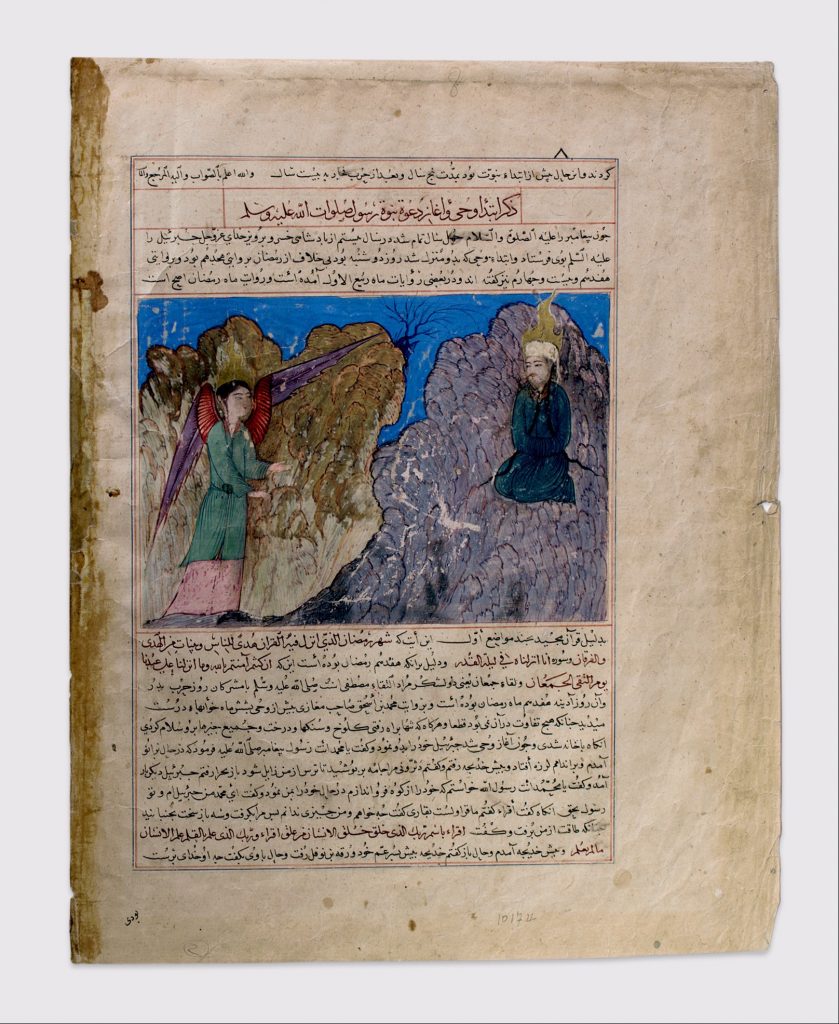
I just read a distressing item by Christiane Gruber in New Lines about an adjunct instructor at Hamline University in St. Paul, Minnesota, whose spring courses were cancelled after a student objected to the display of a medieval Islamic painting of the Prophet Muhammad (peace be upon him) on the grounds that such images were Islamophobic. To be clear, this was in an Islamic art class, and the image in question was produced by a Muslim. In other words, it was a far cry from, for example, the cartoon in Charlie Hebdo.

Gruber, who is a professor of Islamic art at the University of Michigan, points out very clearly that despite public perceptions to the contrary, there is a long history of depicting Muhammad in Islamic art.

“Muhammad’s Call to Prophecy and the First Revelation”, Folio from a Majma’ al-Tavarikh (Compendium of Histories), ca. 1425. New York, Metropolitan Museum of Art 57.51.37.3; Cora Timken Burnett Collection of Persian Miniatures and Other Persian Art Objects, Bequest of Cora Timken Burnett, 1956.

Simply put, this is part of devout Islamic art. But neither the student nor the university was interested in learning this. Instead, the university effectively fired the instructor in question.

Initially I had simply chalked this up to the stupidity of the Hamline administration. After all, they clearly need an expert on Islamic art on the faculty, since they don’t know any about Islamic art. Then I suspected this decision was made by a PR person desperate to avoid even a whiff of racism. But then I realized the simple truth of the matter: the customer is always right. Sadly, in this case one customer got what he or she wanted, but many other customers have been negatively affected by the loss of the courses this instructor could teach and by the fact that this action by the university has demonstrated very publicly that Hamline degrees are worthless, since the university is more concerned with customer satisfaction than with education.

A New Literary Genre

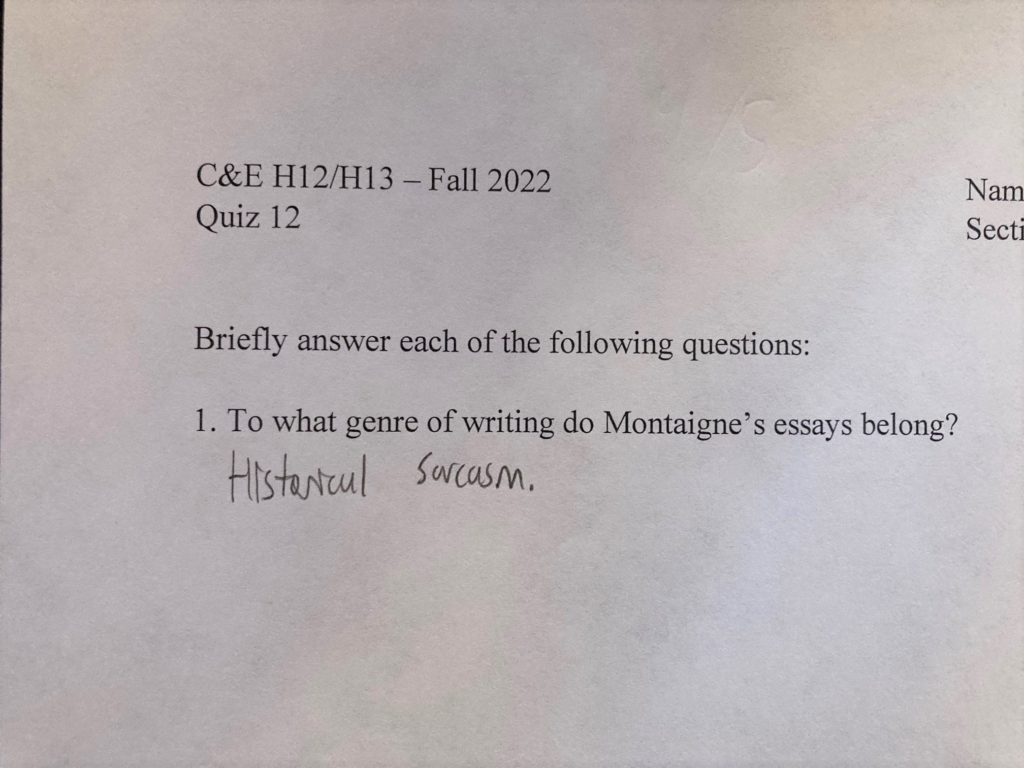
One of the great pleasures of teaching this course for the Honors College at Hofstra is the opportunity to read some really great stuff, like Montaigne’s Essays. Another pleasure is seeing the invention of new literary genres, such as one a student of mine coined to describe Montaigne’s Essays:

I think it may be time for me to branch out into this genre myself!

Palmyra in Perspective

In a few days I depart for Copenhagen for the conference Palmyra in Perspective at the Royal Danish Academy of Sciences and Letters. I have just looked at the conference program, and I will be in esteemed company, including Jen Baird (whose Dura-Europos I highly recommend), Kevin Butcher (one of the finest archaeological numismatists out there), Maura Heyn (whose articles on Palmyrene art I regularly assign to my students) and Eivind Seland (whose scholarship on long-distance trade informs much of my own research), not to mention the conference organizer Rubina Raja, and many others of course. It should be fascinating, and with any luck I won’t make a fool of myself in front of all these archaeological luminaries.